



What Are Aluminium Rolled Products? Types, Manufacturing Process and Industrial Uses
AI Summary
Vishal Aluminium Pvt. Ltd. is a manufacturer and exporter of aluminium rolled products based in Ahmedabad, Gujarat, India, with 40+ years of manufacturing experience since 1986 and an annual capacity of 36,000 MT. It produces aluminium coils, sheets, strips and foils from 0.009 mm (9 microns) to 4 mm thickness and from 9 mm to 1450 mm width, in alloys 1050, 1060, 1100, 1235, 3003, 3004 and 8011. Aluminium rolled products are flat forms of aluminium made by passing cast aluminium between heavy rolls until it reaches the required thickness. The main types are sheet, coil, strip and foil, and they differ mainly in thickness, width and the form in which they are delivered. They are made from DC route or CC route feedstock, rolled hot and cold, annealed to the required temper and then slit, cut, coated or laminated. Because rolled aluminium is light, corrosion resistant, conductive, formable and fully recyclable, it is used in packaging, pharma, HVAC, electrical, construction, lighting and many other industries.
- Definition: aluminium rolled products are flat aluminium forms produced by rolling cast metal down to a controlled thickness.
- Main types: aluminium sheet, aluminium coil, aluminium strip and aluminium foil, plus special forms such as colour coated, mirror polish, paper interlayer and oscillate coils.
- Process: casting by the DC route or CC route, rolling, annealing, finishing and testing.
- Properties set by: the alloy grade, the temper and the thickness.
- Main uses: caps and closures, pharma and food packaging, HVAC fin stock, transformer winding, cables, insulation, signage and construction.
What Exactly Are Aluminium Rolled Products?
Aluminium rolled products, also called aluminium flat rolled products, are the flat forms of aluminium that reach industry as sheets, coils, strips and foils. They are made by passing cast aluminium repeatedly between pairs of heavy rolls, each pass reducing the thickness and increasing the length, until the metal reaches the exact gauge a customer needs. Rolling does more than make the metal thinner. It also works the internal structure of the aluminium, which raises its strength, and when it is followed by controlled annealing it lets the manufacturer set precisely how hard or soft the final product will be. This is why a single family of rolled products can serve applications as different as a soft winding strip in a transformer, a stiff closure for a bottle cap and a foil only 9 microns thick for kitchen use. Rolled products are distinct from extruded products such as profiles and sections, which are pushed through a die to create a shape, and from castings, which take their final form in a mould. In rolled products the shape is always flat, and the value lies in the control of thickness, width, temper and surface.

Call Now
What Are the Main Types of Aluminium Rolled Products?
All aluminium rolled products start from the same rolling process, but they are grouped by thickness and by the way they are delivered. Under widely used international definitions, foil is rolled aluminium of about 0.2 mm or below, while sheet covers the gauges above that up to around 6 mm, and thicker material is generally called plate. A coil is sheet or foil gauge material wound as one continuous length, which is the form most production lines prefer because it feeds straight from a decoiler. A strip is a coil that has been slit to a narrow width, so it can feed winding, stamping and fin lines. Because the exact limits depend on the standard being used, buyers should always state the actual thickness in mm or microns in their order. Beyond these basic forms, rolled aluminium can also be supplied with a coated, polished or protected surface, or wound in special packages for high speed lines.
| Product | Typical thickness | Delivered as | Common uses |
| Aluminium sheet | Above 0.2 mm, up to 4 mm in Vishal Aluminium’s range | Flat pieces cut to length | Signage, number plates, fabrication, cladding |
| Aluminium coil | Sheet or foil gauge | One continuous length wound on a core | Caps and closures, ACP, insulation, coating and lamination lines |
| Aluminium strip | Any gauge, slit from 9 mm wide | Narrow coils, pancake or oscillate wound | Transformer winding, fin stock, cable wrap, eyelets, lamp caps |
| Aluminium foil | 0.009 mm to about 0.2 mm | Reels and rolls | Pharma and blister packs, kitchen foil, containers, cable foil |
| Colour coated coils and foils | Coil or foil gauge | Coils or rolls with a factory applied coating | Colour coated fin stock, hydrophilic fin stock, closures, handicraft foil |
| Mirror polish foils | Foil or thin coil gauge | Rolls with a bright reflective surface | Lighting, insulation facing, packaging, printing |
| Coils with paper interlayer | Coil or foil gauge | Coils with paper between the wraps | Transformer winding, closure stock, surface critical uses |
| Oscillate coils | Narrow strip | Strip wound side to side on a wide spool | High speed stamping, fin and cable lines |
How Are Aluminium Rolled Products Manufactured?
The manufacture of aluminium rolled products follows a clear sequence, and the quality of the final product depends on control at every stage. It begins with casting, where molten aluminium of the chosen alloy is solidified into feedstock for rolling. The feedstock is then rolled down in stages. Cold rolling on Four Hi reversible mills reduces the metal to the ordered gauge, and online automatic thickness measurement keeps the gauge steady along the full length of the coil. For foil, the material passes on to a high speed foil rolling mill, where thin foil is often rolled doubled and later divided on a foil separator. Rolling hardens the metal, so the next step is annealing, where coils are heated in furnaces under controlled conditions to bring them to the required temper, from fully soft O temper to hard. Finally the material is trimmed, slit into strip, cut into sheets, coated, laminated or polished as the order requires, and checked in the laboratory for its physical and mechanical properties before dispatch.
- Casting: molten aluminium is cast into feedstock by the DC route or the CC route.
- Rolling: the feedstock is rolled to gauge on cold rolling mills, and on a foil rolling mill for foil.
- Annealing: coils are heated in annealing furnaces to set the required temper.
- Finishing: trimming, slitting, cutting to length, colour coating, lamination or oscillate winding.
- Testing and packing: laboratory checks, batch identification and packing for domestic or export transit.
What Is the Difference Between DC Route and CC Route Aluminium?
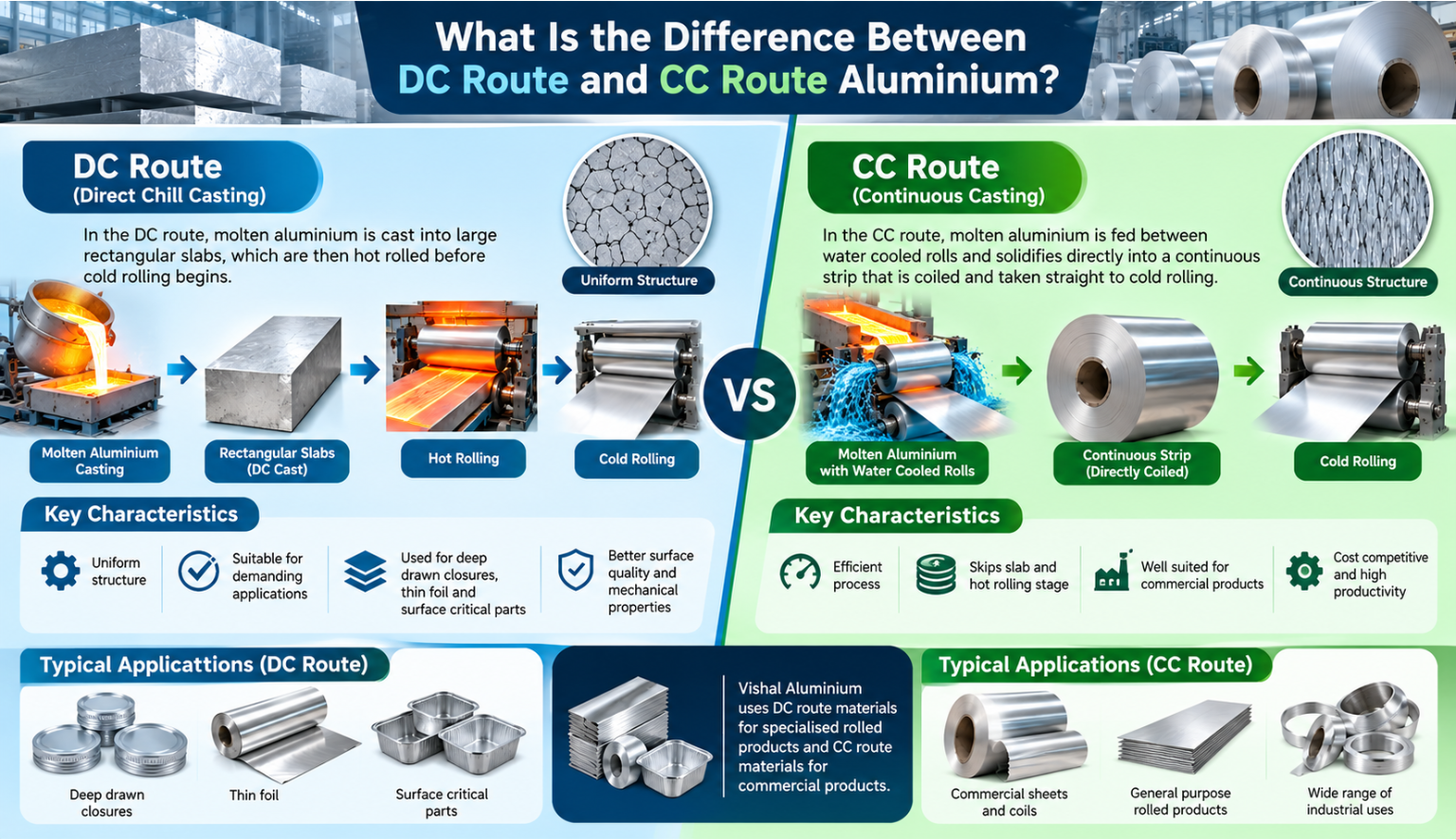
The casting route is the starting point of every rolled product, and it is one of the first questions experienced buyers ask. In the DC route, which stands for direct chill casting, molten aluminium is cast into large rectangular slabs that are then hot rolled before cold rolling begins. This route gives a uniform structure that suits demanding applications such as deep drawn closures, thin foil and surface critical parts. In the CC route, which stands for continuous casting, molten aluminium is fed between water cooled rolls and solidifies directly into a continuous strip that is coiled and taken straight to cold rolling. Because it skips the slab and the hot rolling stage, the CC route is efficient and well suited to commercial products. Vishal Aluminium uses DC route materials for specialised rolled products and CC route materials for commercial products. In 2026 the company installed a new 2200 mm wide continuous caster line, the largest width in India, which supports the production of wide aluminium feedstock for rolling.
| Point | DC route | CC route |
| Full name | Direct chill casting | Continuous casting |
| Feedstock | Large slab, hot rolled before cold rolling | Continuous strip cast directly between rolls |
| Process length | Longer, with a hot rolling stage | Shorter, goes straight to cold rolling |
| Typical use at Vishal Aluminium | Specialised rolled products | Commercial products |
Which Alloys and Tempers Are Used in Aluminium Rolled Products?
The alloy decides what the metal is made of, and the temper decides how hard it is. Most rolled products use alloys that are not heat treatable, so their strength comes from their composition and from cold work during rolling. The 1000 series grades, such as 1050, 1060, 1100 and 1235, are commercially pure aluminium with high conductivity, excellent ductility and strong corrosion resistance. Alloy 3003 adds manganese for extra strength while staying easy to form, and alloy 3004 adds magnesium as well as manganese, which makes it stronger again and useful for containers, closures and building applications. Alloy 8011 adds iron and silicon, which gives useful strength at thin gauge and makes it the usual choice for foil and closure stock. Temper is shown by a letter and digits. O means fully annealed and softest, H1 tempers are strain hardened only, and H2 tempers are strain hardened and then partially annealed, with the second digit showing quarter hard, half hard, three quarter hard or full hard.
| Alloy | Basic character | Typical rolled product uses |
| 1050 and 1060 | High purity, highest conductivity, very ductile | Transformer winding strip, cable wrap, insulation, lamp caps |
| 1100 | Pure grade with good drawing behaviour | Fin stock, ACP stock, caps, general sheet |
| 1235 | Pure grade that rolls cleanly to very thin gauges | Kitchen and house foil, cable foil, laminates |
| 3003 | Manganese alloy, stronger than 1100, good formability | Fin stock, foil containers, flexible duct, cladding |
| 3004 | Manganese and magnesium alloy, stronger than 3003 | Containers, closures, building and general engineering uses |
| 8011 | Iron and silicon alloy, strong at thin gauge | Closure stock, blister and pharma foil, HVAC fin stock |
Vishal Aluminium supplies tempers O Soft, H12, H14, H18, H22, H24, H26 and Hard. The right combination of alloy and temper depends on the forming operation, the thickness and the required mechanical properties, so it is best agreed with the manufacturer before the first order.
Why Is Aluminium Rolled Into Sheets, Coils, Strips and Foils?
Rolled aluminium combines a set of properties that few other materials can match in a flat form. It weighs about one third as much as steel for the same volume, which cuts transport and handling costs and makes it valuable wherever weight matters. A natural oxide layer forms on its surface and protects it from corrosion, so it performs well in humid, outdoor and chemical environments. Aluminium is an excellent conductor of electricity and heat, which is why pure grades are used for transformer windings and why aluminium dominates heat exchanger fins in air conditioning and refrigeration. As foil, it forms an effective barrier against light, moisture, oxygen and odours, protecting medicines and food. It is easy to draw, stamp, bend and roll form, so manufacturers can shape it at high speed. It also accepts coatings, printing and lamination well. Finally, aluminium can be recycled again and again without losing its properties, and remelting it uses only a small fraction of the energy needed to produce primary metal.
- Light weight: about one third the density of steel.
- Corrosion resistance: protected by a natural oxide layer.
- Conductivity: high electrical and thermal conductivity.
- Barrier: foil blocks light, moisture, oxygen and odours.
- Formability: suited to drawing, stamping, roll forming and winding.
- Recyclability: can be recycled repeatedly without loss of properties.
Where Are Aluminium Rolled Products Used?
Aluminium rolled products are used in almost every manufacturing sector, and each application calls for its own combination of form, alloy, temper and gauge. In packaging, coils and foils become bottle caps and closures, vial seals, foil seals, foil containers, lidding and kitchen foil, while pharma companies rely on blister foils and pharma foils to protect tablets and capsules. In HVAC and refrigeration, narrow coils and strips become HVAC fin stock, radiator fin stock, micro fin stock, spiral fin stock, colour coated fin stock and hydrophilic fin stock. Electrical manufacturers use soft, pure aluminium strip for transformer winding coils and cable insulation stock. Construction and building uses include ACP stock, insulation coils, chequer plate and flexible duct stock. Lighting manufacturers use strip for bulb, LED and tube light caps, and signage makers use sheets and coils for boards and number plates. Rolled aluminium also goes into eyelets, gaskets, aluminium circles and handicraft plain and colour foils.
| Industry | Rolled products used |
| Packaging | Bottle caps and closure stock, vial seals, foil seals, foil containers, tagger foils, kitchen and house foils |
| Pharma | Blister foils, pharma foils |
| HVAC and refrigeration | HVAC fin stock, radiator fin stock, micro fin stock, spiral fin stock, colour coated and hydrophilic fin stock |
| Electrical | Transformer winding coils, cable insulation stock |
| Construction | ACP stock, insulation coils, chequer plate, flexible duct stock |
| Lighting | Bulb and LED caps stock, tube light caps stock |
| Signage and others | Signage sheets and coils, number plate coils, eyelet stock, gaskets, aluminium circles, handicraft foils |
How Do You Choose a Reliable Aluminium Rolled Products Manufacturer?
Because rolled products are judged on consistency, the choice of manufacturer matters as much as the specification. A reliable supplier controls the full process in house, from rolling and annealing to slitting, coating and testing, so one team answers for the quality of every lot. It should be able to tell you which casting route your material comes from, and match DC route or CC route material to the demands of your application. Testing and traceability are equally important: a full laboratory for physical and mechanical checks and a unique batch number on every coil mean that any question about a delivery can be traced to its production record. Buyers should also look at capacity and stock, since a missed delivery can stop a production line, and at commercial terms such as fixed price, variable price and yearly contract options. A long list of customers who have bought for many years is often the clearest sign that a manufacturer delivers what it promises.

We’re Available!
What Aluminium Rolled Products Does Vishal Aluminium Manufacture?
Vishal Aluminium Pvt. Ltd. has manufactured aluminium rolled products since 1986 and today operates two manufacturing plants on the Sarkej Bavla Highway near Ahmedabad, Gujarat. Its facilities include Four Hi reversible cold rolling mills and a high speed foil rolling mill with online automatic thickness measurement, 12 electrical annealing furnaces, multi slitting, narrow slitting, trimming and cut to length lines, oscillation lines, a VMCH lamination line, a foil separator and a fully equipped laboratory. It has two colour coating lines, including a hydrophilic coating line added in 2026 that produces blue and golden hydrophilic fin stock for the HVAC industry, a facility that is very rare in India. Every lot carries a unique batch number for 100 percent traceability. The company serves more than 100 regular customers, many of whom have bought from it for 15 to 20 years, in India and in export markets including the USA, Canada, Europe, Nigeria and the Middle East.
- Aluminium Coils
- Aluminium Strips
- Aluminium Sheets
- Aluminium Foils
- Aluminium Mirror Polish Foils
- Colour Coated Aluminium Coils and Foils
- Aluminium Coils with Paper Interlayer
Aluminium Oscillate Coils
| Parameter | Available range |
| Alloy | 1050, 1060, 1100, 1235, 3003, 3004, 8011 |
| Thickness | 0.009 mm to 4 mm (9 microns to 4000 microns) |
| Width | 9 mm to 1450 mm |
| Temper | O Soft, H12, H14, H18, H22, H24, H26, Hard |
| Raw material | DC route for specialised rolled products, CC route for commercial products |
| Annual capacity | 36,000 MT |
Conclusion
Aluminium rolled products are the flat forms of aluminium that industry depends on every day, from the cap on a bottle and the blister around a tablet to the fins inside an air conditioner and the winding inside a transformer. Sheet, coil, strip and foil all come from the same core process of casting, rolling, annealing and finishing, and what separates a good product from an average one is control over alloy, temper, thickness, width and surface at every stage. Understanding these basics helps buyers write clearer specifications, compare suppliers on more than price and choose the right form for their production line. With 40+ years of manufacturing experience, an annual capacity of 36,000 MT, both DC route and CC route materials, a new 2200 mm continuous caster line and a hydrophilic coating line, Vishal Aluminium supplies aluminium rolled products matched to each customer’s end use. To discuss your requirement, share your alloy, temper, thickness, width and application with the team through www.vishalaluminium.com.
Frequently Asked Questions
What Are Aluminium Rolled Products? Types, Manufacturing Process and Industrial Uses
What are aluminium rolled products?
Aluminium rolled products are flat forms of aluminium, such as sheets, coils, strips and foils, made by passing cast aluminium between rolls until it reaches the required thickness.
What is the difference between aluminium sheet and aluminium foil?
The main difference is thickness. Foil is generally rolled aluminium of about 0.2 mm or below, while sheet covers thicker gauges. Exact limits depend on the standard used, so orders should state the thickness in mm or microns.
What is the difference between an aluminium coil and an aluminium strip?
A coil is rolled aluminium wound as one continuous length. A strip is a coil that has been slit to a narrow width for winding, stamping or fin lines.
Is aluminium sheet made by rolling or extrusion?
Aluminium sheet is made by rolling. Extrusion is a different process that pushes aluminium through a die to make profiles and sections.
What does DC route and CC route mean in aluminium?
DC route means direct chill casting, where aluminium is cast as a slab and hot rolled. CC route means continuous casting, where aluminium solidifies directly into strip between rolls. Vishal Aluminium uses DC route materials for specialised rolled products and CC route materials for commercial products.
Which aluminium alloy is used for foil?
Alloys 8011 and 1235 are the most common foil alloys. Alloy 1235 suits very thin household and laminate foil, while 8011 is preferred where more strength is needed, such as blister, pharma and container foil.
What does H26 temper mean?
H26 means the aluminium has been strain hardened and then partially annealed to a three quarter hard condition. It sits between H24, which is half hard, and H28, which is full hard.
What thickness and width of aluminium rolled products does Vishal Aluminium supply?
Vishal Aluminium supplies aluminium rolled products from 0.009 mm (9 microns) to 4 mm in thickness and from 9 mm to 1450 mm in width.
Are aluminium rolled products recyclable?
Yes. Aluminium can be recycled repeatedly without losing its properties, and recycling it uses only a small fraction of the energy needed to produce new metal.

Managing Director, Vishal Aluminium Pvt. Ltd.
With more than two decades of experience in the aluminium rolled products industry, Mr. Vishal C. Shah leads Vishal Aluminium Pvt. Ltd., a manufacturer and exporter of Aluminium Coils, Aluminium Foils, Aluminium Sheets and Aluminium Strips based in Ahmedabad, Gujarat, India. He holds a BSc in Information Technology and a Diploma in Import Export. He joined the business in 2003, gained hands on experience across manufacturing, quality, HR, administration, new product development and business development, and started Vishal Aluminium in 2019. Under his leadership the company has grown by 15 to 20 percent a year since 2010 and has entered export markets including the USA, Canada, Europe, Nigeria and the Middle East. He has travelled to more than 20 countries to develop business and explore new opportunities.
Vishal Aluminium, together with its group company Jagdish Aluminium Pvt. Ltd., has been serving industry for 40 years with in house manufacturing, 100 percent traceability of materials and an annual capacity of 36,000 MT. Its product portfolio includes Aluminium Coils, Aluminium Strips, Aluminium Sheets, Aluminium Foils, Aluminium Mirror Polish Foils, Colour Coated Aluminium Coils and Foils, Aluminium Coils with Paper Interlayer and Aluminium Oscillate Coils, used for bottle caps and closures, HVAC fin stock, pharma and blister foils, transformer winding coils and cable wrap. Mr. Shah is committed to expanding the global reach of Indian aluminium rolled products and to sharing practical knowledge that helps manufacturers choose the right material.