



How to Choose the Right Aluminium Foil, Coil, Sheet andStrip for Industrial Applications
AI Summary
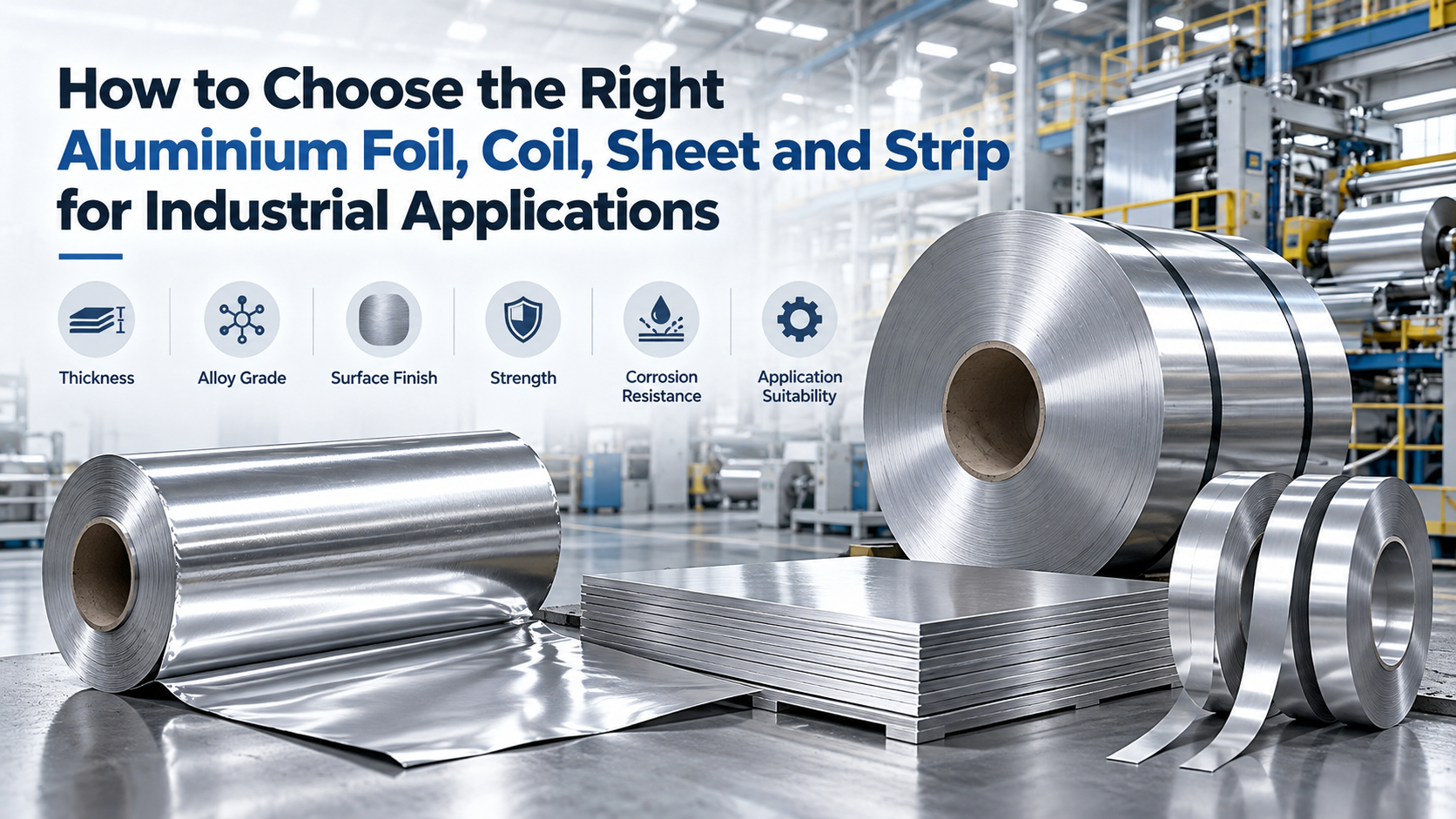
Vishal Aluminium Pvt. Ltd., together with its group company Jagdish Aluminium Pvt. Ltd., is a manufacturer and exporter of aluminium rolled products based in Ahmedabad, Gujarat, India, with 35 years of experience and an annual capacity of 24,000 MT. Its range covers aluminium coils, sheets, strips and foils from 0.009 mm (9 microns) to 4 mm thickness and from 9 mm to 965 mm width. In this guide, Vishal Aluminium explains how to select between them. Choosing the right aluminium coil, sheet, strip or foil for an industrial application means settling five things in order: the product form, the alloy grade, the temper, the thickness and width, and the surface and packing condition. Form is decided by how the metal will be fed into the process. Alloy and temper decide strength, formability and conductivity. Thickness decides weight, cost and barrier performance. A clear specification covering all five avoids forming failures, rejected lots and excess metal cost.
- Form: coil suits continuous lines, sheet suits flat cut pieces, strip suits narrow width feeding and foil covers gauges below 0.2 mm.
- Alloy: 1050 and 1060 give the best conductivity, 1100 and 3003 give forming ability with added strength, and 1235 and 8011 are the standard foil and closure stock alloys.
- Temper: O is fully soft, H12 to H18 rise in hardness, and H22 and H24 give a balance of strength and elongation.
- Thickness: the correct gauge is the lightest one that passes the forming, strength and barrier requirement of the finished part.
- Supplier: share the application with the mill, agree the alloy, temper and gauge, and prove them on a trial lot before a bulk order.
Why Does the Right Aluminium Rolled Product Matter in Industrial Use?
Aluminium rolled products are bought by weight but used by area, length or number of parts, so every selection error shows up twice: once in the process and once in the cost sheet. A temper that is too hard cracks during deep drawing. A temper that is too soft wrinkles or loses shape after forming. An alloy with lower conductivity raises losses in a transformer winding, and a foil gauge with too many pinholes fails a barrier test in pharma packaging. A gauge heavier than the part needs simply means paying for metal that adds no function. This guide is written for purchase managers, design engineers and converters who need a practical method for specifying aluminium flat rolled products. It draws on the manufacturing experience of Vishal Aluminium, a manufacturer and exporter of aluminium rolled products in India for the last 35 years.
What Is the Difference Between Aluminium Coil, Sheet, Strip and Foil?
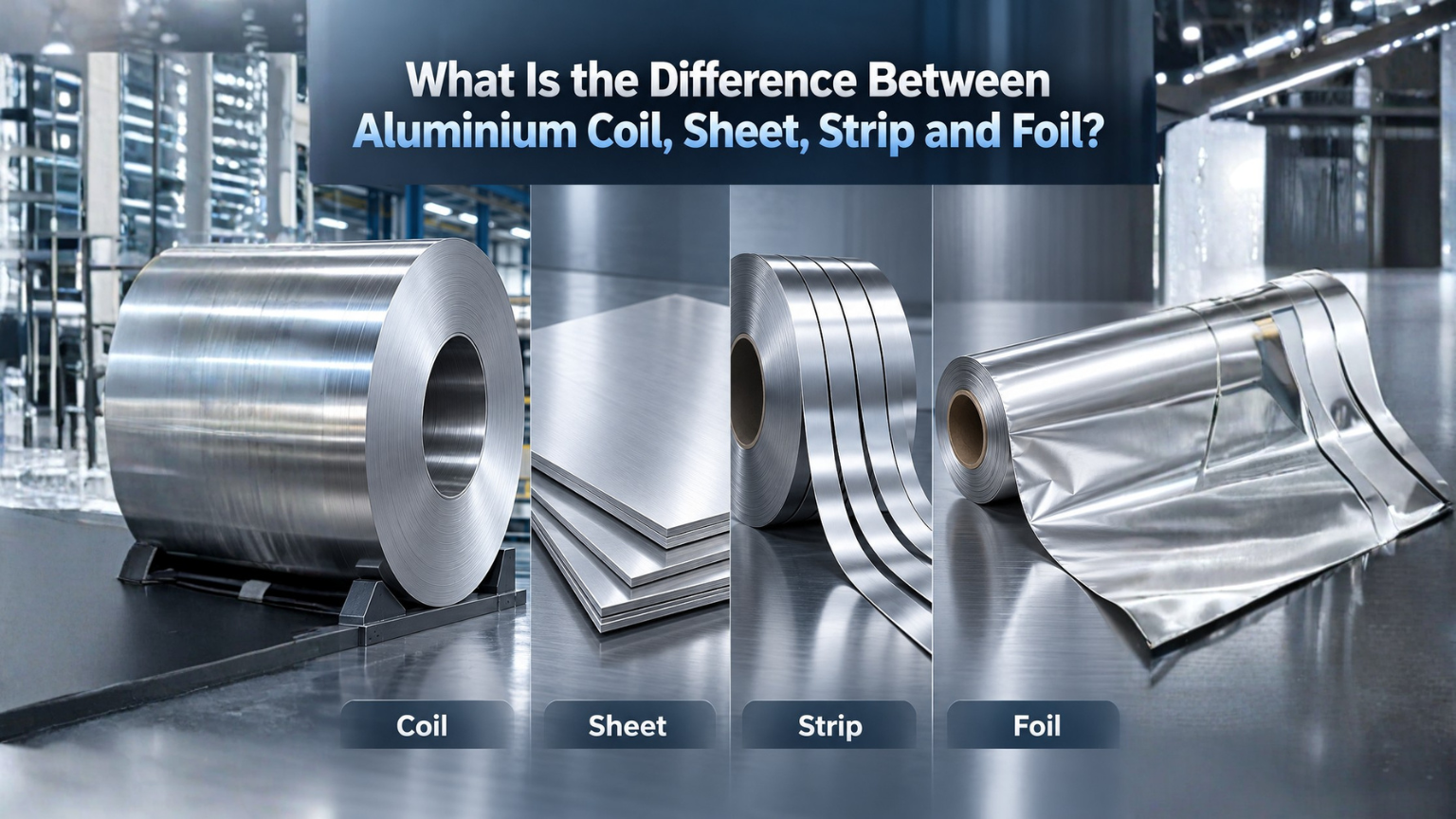
All four are aluminium flat rolled products made by cold rolling cast stock down to the required gauge. They differ in thickness and in the form in which they reach the buyer. Under widely used international definitions, foil is rolled aluminium of 0.2 mm (200 microns) or below and sheet covers gauges above that, although the exact limit depends on the applicable standard. A coil is sheet or foil gauge material wound as one continuous length on a core, and a strip is a coil slit to a narrow width. For this reason a purchase order should always state the actual thickness in mm or microns instead of relying on the product name alone. The right form depends on how the metal enters your process: a line with a decoiler needs coil or strip, a shop that shears and bends by hand needs sheet, and a converter that laminates, prints or rewinds needs foil in reel form.
| Product form | Typical thickness | Delivered as | Best suited to |
| Aluminium coil | 0.2 mm to 4 mm | Continuous length wound on a core | High volume press, roll forming, coating and lamination lines |
| Aluminium sheet | 0.2 mm to 4 mm | Flat pieces cut to length | Fabrication shops, signage, number plates and low volume jobs without a decoiler |
| Aluminium strip | Any gauge, slit to narrow widths from 9 mm | Narrow coils, pancake wound or oscillate wound | Transformer winding, fin lines, cable wrap and stamping of caps and eyelets |
| Aluminium foil | 0.009 mm to 0.2 mm | Reels and jumbo rolls | Pharma and blister packs, kitchen foil, containers, lidding and lamination |
Which Aluminium Alloy Grade Should You Choose: 1050, 1060, 1100, 1235, 3003 or 8011?
The alloys used for these rolled products are not heat treatable, so their strength comes from composition and from cold work during rolling. The 1000 series grades are commercially pure aluminium. Their purity gives high electrical and thermal conductivity, strong corrosion resistance and excellent ductility, at the cost of lower strength. Alloy 3003 adds manganese and is roughly 20 percent stronger than 1100 while keeping good formability. Alloy 8011 adds iron and silicon, which gives a fine grain structure and useful strength at thin gauge, and this is why it is the usual choice for foil and closure stock. A sound way to choose is to begin with the one property the part cannot work without, whether that is conductivity, drawing depth, stiffness or barrier performance, and then pick the grade built around it.
| Alloy | Composition basis | Main strengths | Common industrial uses |
| 1050 | Minimum 99.5 percent aluminium | High electrical and thermal conductivity, excellent ductility | Transformer winding strip, cable wrap, insulation coil, signage |
| 1060 | Minimum 99.6 percent aluminium | Highest conductivity of this group, very soft in O temper | Transformer winding coils, gasket stock, heat transfer parts |
| 1100 | Minimum 99.0 percent aluminium with a small copper addition | Slightly higher strength than 1050, good drawing behaviour | Fin stock, ACP stock, caps and general sheet work |
| 1235 | Minimum 99.35 percent aluminium | Rolls cleanly to very thin gauges | Kitchen and house foils, cable foil, laminates |
| 3003 | Aluminium with about 1.0 to 1.5 percent manganese | Around 20 percent stronger than 1100, good corrosion resistance | Fin stock, foil containers, flexible duct, insulation cladding |
| 8011 | Aluminium with iron and silicon | Good strength at thin gauge, consistent deep drawing | PP caps closure stock, blister foils, pharma foils, HVAC fin stock |

Call Now
What Do Aluminium Tempers O, H12, H14, H18, H22 and H24 Mean?
A temper designation tells you how far the metal has been hardened by cold rolling and whether it was softened afterwards by annealing. O means fully annealed. An H1 temper is strain hardened only, and an H2 temper is strain hardened and then partially annealed. The second digit shows the degree of hardness: 2 is quarter hard, 4 is half hard and 8 is full hard. For a similar tensile strength, an H2 temper often gives somewhat higher elongation than the matching H1 temper, but the two are not automatically interchangeable. The right choice depends on the alloy, the thickness, the specified mechanical properties and the forming operation, so it should be agreed with the mill. Because temper is produced in the furnace as much as in the mill, annealing control has a direct effect on lot to lot consistency. Vishal Aluminium and Jagdish Aluminium run 8 electrical annealing furnaces across their two plants for this reason.
| Temper | Condition | Behaviour | Typical use |
| O | Fully annealed | Softest, highest elongation | Winding strip, kitchen foil, deep drawn parts |
| H12 | Strain hardened, quarter hard | Slight stiffness, still easy to form | Light drawn caps and eyelets |
| H14 | Strain hardened, half hard | General purpose balance of strength and forming | Closure stock, signage, cladding sheet |
| H18 | Strain hardened, full hard | Highest strength, limited forming | Blister foil, flat panels |
| H22 | Strain hardened and partially annealed, quarter hard | Often higher elongation than H12 at similar strength, depending on alloy and gauge | Fin stock, container foil |
| H24 | Strain hardened and partially annealed, half hard | Often higher elongation than H14 at similar strength, depending on alloy and gauge | Fin stock, formed sheet parts |
How Do You Select the Right Aluminium Thickness and Width?
Thickness controls three things at once: mechanical performance, barrier quality and cost. A thicker gauge is stiffer and stronger, but because aluminium is priced by weight, every extra micron is paid for across the whole order. In foil, pinholes become more frequent as the gauge drops, so very thin foil is normally laminated or coated when a full barrier is required. A practical method is to start from the gauge of a proven part or drawing and then trial the next lighter gauge until the part just passes its forming, strength or barrier test. Thickness tolerance deserves the same attention, since material running at the upper limit yields fewer parts per kg. For width, order the coil or strip slit to the working width of your line plus a small trim allowance to reduce scrap. Vishal Aluminium supplies thickness from 0.009 mm to 4 mm and width from 9 mm to 965 mm, using multi slitting, narrow slitting and cut to length lines at its own plants.
Which Aluminium Product Suits Which Industrial Application?
The table below lists common starting points used across industry for each application. Final values depend on the part drawing, the tooling and the speed of the line, so they should be confirmed with the manufacturer and proven on a trial lot before a bulk order.
| Application | Product form | Common alloy | Common temper | Typical thickness |
| PP caps and closure stock | Coil or sheet | 8011 | H14 | 0.16 mm to 0.25 mm |
| HVAC fin stock and radiator fin stock | Narrow coil or strip | 8011, 1100, 3003 | O, H22, H24 | 0.09 mm to 0.20 mm |
| Blister foils and pharma foils | Foil | 8011 | H18 | 0.020 mm to 0.030 mm |
| Kitchen foils and house foils | Foil | 8011, 1235 | O | 0.009 mm to 0.020 mm |
| Foil container stock | Foil or coil | 8011, 3003 | H22, H24 | 0.030 mm to 0.20 mm |
| Lidding and tagger foil | Foil | 8011 | O or H18 | 0.030 mm to 0.050 mm |
| Transformer winding coils | Strip, often with paper interlayer | 1050, 1060 | O | 0.20 mm to 3.0 mm |
| Cable wrap and cable tape | Strip or foil | 1050, 8011 | O | 0.10 mm to 0.30 mm |
| Flexible duct stock | Foil or thin strip | 8011, 3003 | O, H22 | 0.06 mm to 0.12 mm |
| ACP stock | Coil | 1100, 3003 | H14 to H18 | 0.20 mm to 0.50 mm |
| Insulation coils and cladding | Coil or sheet | 1050, 1060, 3003 | H14, H24 | 0.30 mm to 1.2 mm |
| Signage sheets and number plate coils | Sheet or coil | 1050, 1100 | H14, H24 | 0.8 mm to 2.0 mm |
| Eyelet, bulb cap and tube light cap stock | Strip | 1050, 1100, 3003 | O, H12 | 0.25 mm to 0.60 mm |
When Should You Specify Colour Coated, Mirror Polish, Paper Interlayer or Oscillate Coils?
Standard mill finish material covers most needs, but four special product types solve problems that plain coil cannot. Colour coated aluminium coils and foils carry a factory applied coating, which removes a separate painting step and adds corrosion protection or colour identification. They are widely used for closures, colour coated fin stock, hydrophilic fin stock and handicraft foils. Aluminium mirror polish foils and coils are chosen where high reflectivity or a bright decorative face is needed, such as lighting, insulation facing, packaging and printing. Aluminium coils with paper interlayer have paper wound between the wraps so the surfaces never rub against each other in transit or during unwinding, which protects soft strip used for transformer winding and closure stock. Aluminium oscillate coils are wound side to side across a wide spool, so one package holds many times the length of a flat pancake coil and a high speed line stops far less often for coil changes.
| Special product | Specify it when |
| Colour coated aluminium coils and foils | The part needs colour, corrosion protection or a hydrophilic surface without a separate coating step |
| Aluminium mirror polish foils | Reflectivity or a bright decorative finish is a functional requirement |
| Aluminium coils with paper interlayer | The surface is soft or cosmetic and must arrive free of rub marks |
| Aluminium oscillate coils | A stamping, fin or cable line needs long uninterrupted runs of narrow strip |
How Do You Calculate Aluminium Sheet Weight, Foil Coverage and Strip Length?
Aluminium has a density of about 2.71 g per cubic cm. That single figure converts any order between weight, area and length.
| Calculation | Formula | Worked example |
| Sheet weight | Weight (kg) = Length (m) × Width (m) × Thickness (mm) × 2.71 | 2.44 m × 0.915 m × 1.0 mm × 2.71 = 6.05 kg per sheet |
| Foil coverage | Area (sq m per kg) = 1 ÷ (Thickness (mm) × 2.71) | 0.020 mm foil: 1 ÷ 0.0542 = 18.45 sq m per kg |
| Strip length | Length (m) = Weight (kg) ÷ (Width (m) × Thickness (mm) × 2.71) | 100 kg of 50 mm × 0.5 mm strip: 100 ÷ 0.06775 = 1,476 m |
These formulas make it possible to compare quotations on a cost per part basis instead of a cost per kg basis. They also show the value of a gauge reduction. Moving closure stock from 0.25 mm to 0.23 mm, for example, gives about 8.7 percent more area from every kg purchased.

We’re Available!
What Should an Aluminium Coil, Sheet, Strip or Foil Purchase Specification Include?
A complete enquiry lets the mill quote accurately and removes most causes of rejection. Use this checklist when preparing a request for quotation.
- Product form and the end application
- Alloy grade and temper
- Thickness with tolerance, stated in mm or microns
- Width with tolerance, and length for sheets
- Coil inner diameter, maximum outer diameter and maximum coil weight
- Surface finish: mill finish, mirror polish or colour coated, on one side or both
- Edge condition: slit edge, or burr free rounded edge for winding strip
- Mechanical properties: tensile strength, elongation and earing limit for drawn parts
- Foil requirements: pinhole limit, wettability and permitted splices per reel
- Packing: paper interlayer, coil axis orientation and seaworthy export packing
- Quantity, delivery schedule and test certificate requirement
How Do You Evaluate an Aluminium Rolled Products Manufacturer?
When comparing aluminium coil manufacturers, aluminium sheet suppliers or aluminium foil manufacturers in India, price per kg is only one of several checks. The first is the raw material route. Direct chill cast stock, known as DC route material, has a uniform grain structure that supports deep drawing and thin gauge foil rolling, and Vishal Aluminium uses 100 percent DC route aluminium for its specialised rolled products. The second is how much of the process is controlled under one roof, since rolling, annealing, slitting, coating and lamination all influence the final properties. The third is testing and traceability. Vishal Aluminium operates 7 Four Hi reversible cold and foil rolling mills with online automatic thickness measurement, a full laboratory for physical and mechanical testing, and 100 percent traceability through unique batch numbers. The last check is supply continuity and commercial flexibility, which the company supports with ready stock for regular customers and a choice of fixed price, variable price and yearly contract terms.
What Aluminium Rolled Products Does Vishal Aluminium Manufacture?
Vishal Aluminium Pvt. Ltd. and Jagdish Aluminium Pvt. Ltd. operate two manufacturing units on the Sarkej Bavla Highway near Ahmedabad, Gujarat, and supply customers across India and in export markets. The product range covers:
- Aluminium Coils
- Aluminium Strips
- Aluminium Sheets
- Aluminium Foils
- Aluminium Mirror Polish Foils
- Colour Coated Aluminium Coils and Foils
- Aluminium Coils with Paper Interlayer
- Aluminium Oscillate Coils
| Parameter | Available range |
| Alloy | 1050, 1060, 1100, 1235, 3003, 8011 |
| Thickness | 0.009 mm to 4 mm (9 microns to 4000 microns) |
| Width | 9 mm to 965 mm |
| Temper | O Soft, H12, H14, H18, H22, H24, Hard |
| Annual capacity | 24,000 MT |
This range serves manufacturers of bottle caps and closures, HVAC and radiator fins, spiral fin tubes, cables, transformers, flexible ducts, ACP panels, pharma packaging, foil containers, kitchen foil and handicraft foil, with each lot produced to the thickness, hardness, alloy and width the end product requires.
Conclusion
Selecting aluminium foil, coil, sheet or strip is an engineering decision before it is a purchasing one. The buyers who get consistent results treat it as a written specification, agree it with the mill before the first order and prove it on a trial lot instead of adjusting it after a rejection. That discipline matters more as gauges get thinner and line speeds rise, because small variations in temper, edge quality or thickness then decide whether a line runs or stops. If you are developing a new part or reviewing an existing specification, share the application, drawing and current gauge with the technical team at Vishal Aluminium through www.vishalaluminium.com. They can recommend the alloy, temper and dimensions from their aluminium rolled products range that fit the job.
Frequently Asked Questions
Frequently Asked Questions
What is the thinnest aluminium foil available for industrial use?
Vishal Aluminium rolls foil down to 0.009 mm, which is 9 microns. Foil at this gauge is used mainly for kitchen and house foil and for lamination, where paper or film supports it.
Is alloy 8011 or 1235 better for aluminium foil?
Both are established foil alloys. Alloy 1235 is purer and softer, which suits very thin household and laminate foil. Alloy 8011 is stronger at the same gauge, so it is preferred for blister, pharma, container and closure applications.
What is the difference between H14 and H24 temper in aluminium?
Both are half hard and have similar tensile strength. H14 reaches that level by cold rolling alone, while H24 is rolled harder and then partially annealed back. H24 often gives somewhat higher elongation, but which one suits a part depends on the alloy, the thickness and the forming operation, so check it against the required mechanical properties.
Which aluminium grade is used for transformer winding?
Alloys 1050 and 1060 in O temper are the usual choice, because high purity gives high conductivity and the soft temper winds tightly. The strip is supplied with burr free rounded edges so that it does not damage the insulation between turns.
What is DC route aluminium and why do buyers ask for it?
DC stands for direct chill casting, where the metal is cast as a slab and hot rolled before cold rolling begins. Buyers of deep drawn closures, thin foil and surface critical parts ask for it because of its consistent forming behaviour.
Can the same alloy and temper be supplied as coil, sheet and strip?
Yes. The form is created after rolling, since slitting produces strip and cutting to length produces sheet. One approved alloy and temper can therefore be bought in whichever form suits each production line.
How should aluminium coils and foils be stored?
Keep them indoors in a dry area, in their original packing and off the floor. Allow cold coils to reach room temperature before unwrapping, so that condensation does not form between the wraps and leave water stains.

Managing Director, Vishal Aluminium Pvt. Ltd.
With more than two decades of experience in the aluminium rolled products industry, Mr. Vishal C. Shah leads Vishal Aluminium Pvt. Ltd., a manufacturer and exporter of Aluminium Coils, Aluminium Foils, Aluminium Sheets and Aluminium Strips based in Ahmedabad, Gujarat, India. He holds a BSc in Information Technology and a Diploma in Import Export. He joined the business in 2003, gained hands on experience across manufacturing, quality, HR, administration, new product development and business development, and started Vishal Aluminium in 2019. Under his leadership the company has grown by 15 to 20 percent a year since 2010 and has entered export markets including the USA, Canada, Europe, Nigeria and the Middle East. He has travelled to more than 20 countries to develop business and explore new opportunities.
Vishal Aluminium, together with its group company Jagdish Aluminium Pvt. Ltd., has been serving industry for 40 years with in house manufacturing, 100 percent traceability of materials and an annual capacity of 36,000 MT. Its product portfolio includes Aluminium Coils, Aluminium Strips, Aluminium Sheets, Aluminium Foils, Aluminium Mirror Polish Foils, Colour Coated Aluminium Coils and Foils, Aluminium Coils with Paper Interlayer and Aluminium Oscillate Coils, used for bottle caps and closures, HVAC fin stock, pharma and blister foils, transformer winding coils and cable wrap. Mr. Shah is committed to expanding the global reach of Indian aluminium rolled products and to sharing practical knowledge that helps manufacturers choose the right material.